Key Takeaways
- GPU depreciation moved from footnote to headline: Assumptions about GPU useful-life now swing reported earnings by billions of dollars. One widely cited estimate puts the cumulative impact at over $176 billion from 2026 to 2028 if the largest cloud operators shorten their schedules.
- The GPU value cascade is the load-bearing assumption: Longer GPU useful-life estimates rest on the idea that hardware steps down a value cascade from frontier training to production inference to batch work. That cascade only holds if a market exists that will pay for mid-life capacity.
- The secondary GPU market already prices the answer: Used A100 and H100 hardware still clears at meaningful GPU residual value, and inference economics keep older accelerators earning.
- AI infrastructure depreciation is a risk somebody owns: Buying hardware outright or committing to multi-year reserved capacity transfers residual value risk onto the buyer. On-demand capacity leaves that risk with the operator who chose the hardware.
- Aethir’s decentralized GPU cloud is the clearing layer: Aethir aggregates enterprise GPU capacity from independent operators across 94 countries, giving mid-life hardware a live venue and buyers a price set by competition rather than by a single balance sheet.
The GPU Depreciation Debate Reached the Balance Sheet
For most of the cloud era, GPU depreciation was a footnote. In 2026 it is a headline, because the assumption a company makes about GPU useful life flows straight into reported earnings. A detailed review of useful lives for AI hardware traces the argument from a public claim that large cloud providers overstate profits by writing down accelerators too slowly, with a cumulative earnings impact of over $176 billion for 2026 through 2028 if schedules were moved to a two- to three-year replacement cycle. That debate sits atop the same supply conditions that are now pushing GPU cloud pricing higher.
Amazon Shortened
In 2025, Amazon cut the estimated useful life of a subset of its servers from six years to five, citing the pace of AI hardware development, and booked roughly $920 million in accelerated depreciation. That is a GPU depreciation schedule that responds to deployment data rather than to accounting convenience.
Meta Extended
Meta moved the other way, lifting server useful lives to about 5.5 years and reducing depreciation expense by roughly $2.9 billion. Two large operators looked at broadly similar hardware and reached opposite conclusions about GPU useful life.
NVIDIA Pushed Back
NVIDIA has argued that customers observe four- to six-year depreciable lives based on real utilization and longevity, a position examined closely in one analysis of useful lives and useful myths. The spread between two and six years is the whole argument, and AI infrastructure depreciation policy lives inside it.
The Value Cascade Needs a Market to Cascade Into
Every defense of a longer GPU useful life rests on one load-bearing assumption: a GPU value cascade. Work on how AI factories handle useful-life assumptions describes hardware moving down tiers over time, from frontier training in the first years to production inference, then to batch and lower-value work later. The logic is sound. The gap is that a cascade is not an accounting entry. It is a transaction, and a transaction needs a counterparty.
What a Cascade Actually Requires
A buyer at every tier: GPU residual value only materializes if someone will pay for year-four capacity at year-four prices. Guidance on optimizing GPU asset lifecycles treats redeployment as an operational choice, but the company's demand curve constrains redeployment within the company.
A venue with liquidity: Centralized operators can mostly cascade hardware into their own product lines, which means the internal transfer price is set by the same balance sheet that owns the asset. Without an external venue, an assumption about AI infrastructure depreciation is self-certified rather than market-tested.
A workload that fits: The GPU value cascade works because inference tolerates older silicon far better than frontier training does, a pattern visible across the shift toward inference-heavy demand. Without that workload mix, the later tiers of the cascade have nothing to sell.
What the Secondary GPU Market Actually Pays
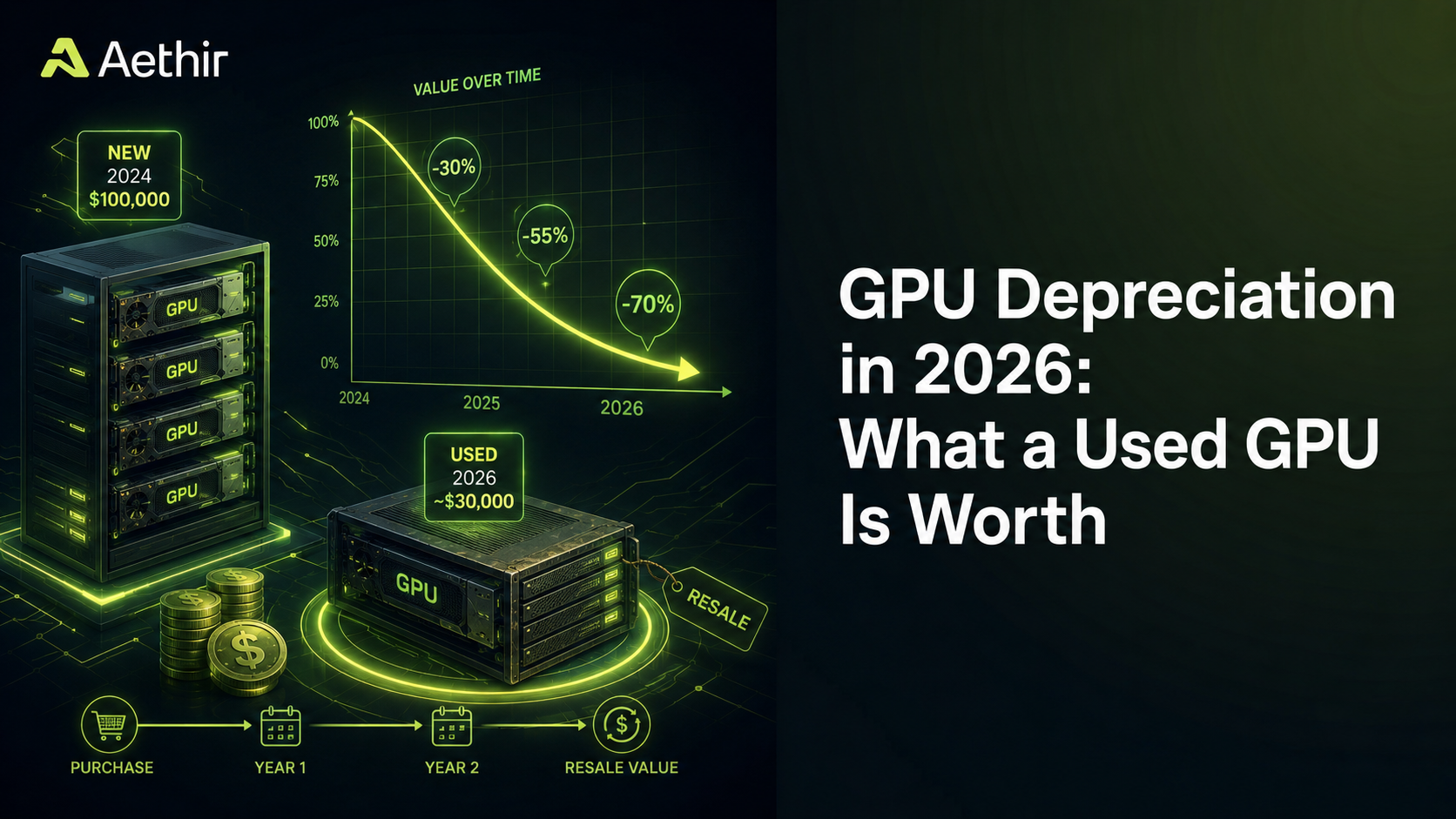
Set the schedules aside for a moment and look at the clearing price. Data on used GPU pricing and depreciation show A100 80GB cards changing hands for roughly $12,000 to $18,000, holding a substantial share of their original cost years after release. The used H100 price tells a sharper story, with cards that sold for near $40,000 in late 2023 now moving for a fraction of that. The GPU residual value isn’t zero, and it isn't the straight line a depreciation schedule produces, which is why Aethir’s compute buyer guide's framing starts with workload fit rather than list price.
Residual Value Is Real but Front-Loaded
Terminal demand from research, gaming, and smaller operators sets a practical floor near 10% to 20% of original cost. Most of the decline happens early, which means straight-line accounting flatters the middle years and understates the first ones.
Inference Economics Keep Older Cards Earning
A100 class capacity rents around $0.87 to $1.39 per hour for single-GPU inference against roughly $2.69 to $3.78 for H100 class capacity, however, Aethir’s H100S come even cheaper, at $1.25 per hour. Older hardware doesn’t stop working. It stops being the cheapest way to do the newest thing, which is exactly what keeps AI compute costs workable for teams serving steady traffic.
The Buy Decision Has Changed Shape
A used H100 server at $150,000 to $180,000 against roughly $500,000 for a new B300 server is a different business case entirely. Operators price that gap in the secondary GPU market every day, long before any auditor signs off on a useful life estimate.
How Aethir’s Decentralized GPU Cloud Treats Mid-Life Hardware
Aethir’s decentralized GPU cloud is, structurally, the venue the GPU value cascade has been missing. Aethir aggregates enterprise GPU capacity from independent operators into a single orchestrated pool spanning more than 430,000 GPU containers across 94 countries and 200+ locations, and the economics of AI inference favor exactly the steady, distributed workloads that mid-life accelerators serve well. Capacity that would sit idle on a single balance sheet meets demand on a network instead.
Utilization Instead of Idleness
The Aethir network runs at over 95% GPU utilization, compared to the 60% to 70% typical of centralized fleets, and the case for cost-efficient inference infrastructure rests on aggregating capacity that would otherwise be stranded. High utilization is what turns a depreciating asset back into a producing one.
Independent Operators and Competitive Pricing
Supply comes from many independent Cloud Hosts monetizing their GPUs, not from one owner, so prices track real market conditions. That is the difference between a self-certified AI infrastructure depreciation assumption and one the market has actually tested.
Rental Data Beats Accounting Estimates
Continuous tracking of the GPU rental market gives buyers a live read on what capacity is worth right now. That signal is what any honest GPU depreciation model needs, and it is what the secondary GPU market supplies for hardware.
Who Carries GPU Depreciation Risk in Your Contract
Depreciation is not an abstraction for buyers. Whoever holds the asset, or commits to it for years, carries the risk that it will be worth less than planned, a point made plainly in outlook work on GPU residual values through 2026. The arrival of new architectures sharpens it, because each hardware generation re-prices the fleet behind it. A GPU depreciation schedule you didn’t choose can still land on your budget.
Matching the Contract Term to the Risk
- Ownership means you own the curve: Buying hardware outright puts the full AI infrastructure depreciation question on your balance sheet, including the residual value assumption and the upgrade timing. For stable, always-full workloads that can be the right call, and it should be made deliberately rather than by default.
- Long reservations rent the risk too: Multi-year reserved contracts fix a price against hardware that will not stay current for the whole term, which is why capital-efficient access to GPUs matters more than raw capacity. Reserved capacity generally needs sustained utilization in the 60%-70% range before it beats consumption pricing.
- On-demand leaves the risk where it belongs: With no minimum commitment, no long-term contract, and no egress fees, decentralized GPU cloud capacity keeps residual value exposure with the operator who selected the hardware. When a new NVIDIA platform ships, the workload moves without renegotiation or write-down.
Aethir delivers enterprise GPU compute on demand across 94 countries with no long-term contracts, no minimum commitments, and no egress fees, so AI compute costs track actual usage rather than a hardware bet somebody else made.
Mid-life capacity keeps earning on the network, frontier hardware is available when the workload needs it, and the residual value curve stays with the operator.
Explore the Aethir enterprise GPU offering to see how it compares with your current commitments.
Frequently Asked Questions
What is GPU depreciation and why does it matter in 2026?
GPU depreciation is the process by which an operator spreads the cost of an accelerator over the years it expects to use the hardware. It matters because the assumed GPU useful life flows directly into reported earnings and into the prices buyers pay for compute. In 2026, large operators disagree by more than a year on the right GPU depreciation schedule, so the assumption itself has become a competitive variable.
How long is the useful life of an AI GPU?
Published estimates range from four to six years, with NVIDIA citing observed utilization at the longer end, while some operators have shortened to five. The honest answer is that GPU useful life is a range shaped by workload mix, data center design, and maintenance practice rather than a single number. Two companies can look at the same accelerator and reasonably land in different places.
Do older GPUs still have residual value?
Yes. Inference workloads are the main reason older accelerators keep earning, because they tolerate previous-generation silicon far better than large synchronized training runs do.
How does Aethir’s decentralized GPU cloud change depreciation risk?
A decentralized GPU cloud lets buyers rent capacity on demand rather than own it or commit for years, which shifts the risk of hardware depreciation to the operator who selected the hardware. Aethir aggregates supply from independent operators across 94 countries, so pricing reflects competition within the pool rather than a single depreciation policy. Buyers gain access to current hardware without inheriting the residual value curve associated with it.