Key Takeaways
AI’s biggest cost driver isn’t training. It’s the continuous cost of inference workloads.
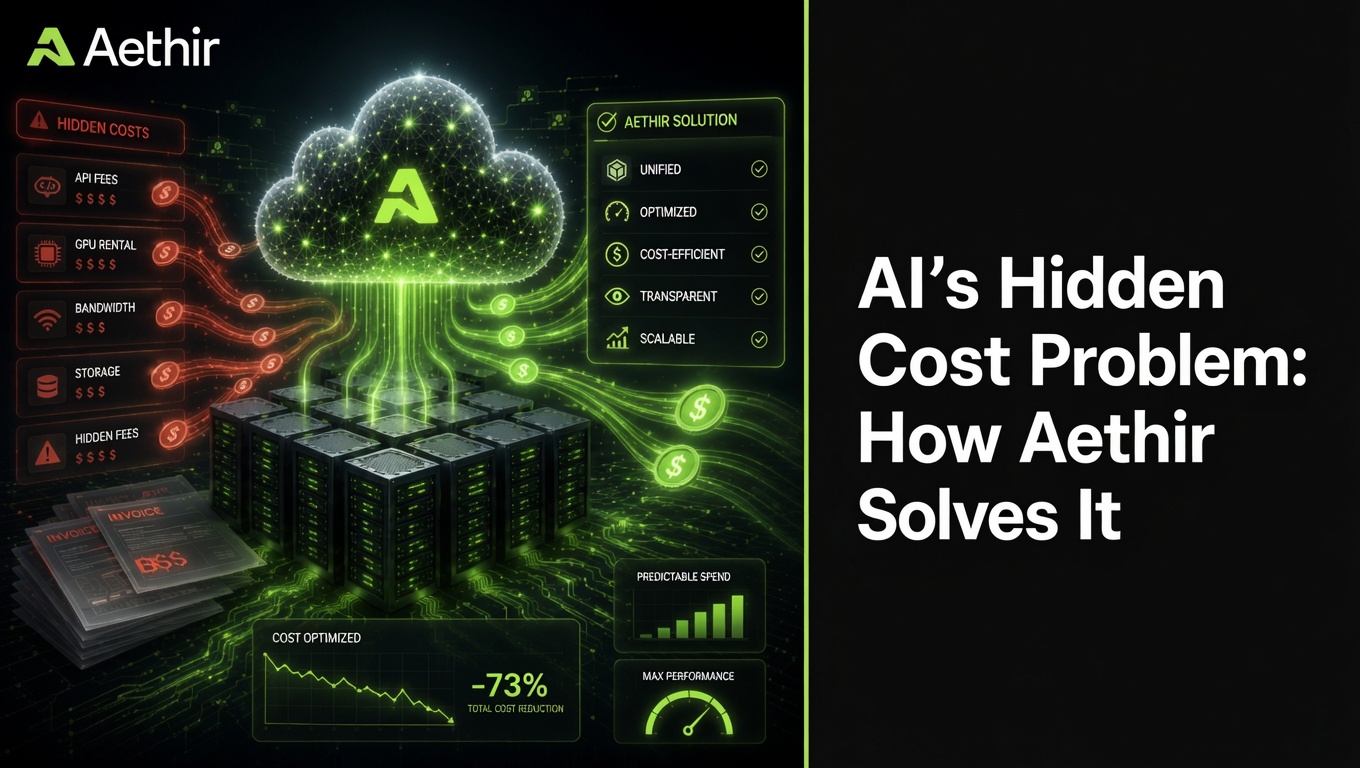
Centralized hyperscaler clouds often lead to higher GPU prices due to overprovisioning and infrastructure overhead.
Decentralized GPU cloud networks reduce AI infrastructure costs by aggregating unused GPU capacity globally.
Aethir’s decentralized GPU cloud enables scalable, low-latency AI inference infrastructure at up to 86% lower cost compared to centralized hyperscalers.
As the AI industry continues to evolve rapidly, infrastructure cost-efficiency has become a key challenge for AI scalability. There are hundreds of commercial AI models developed for various use cases, not just the leading ones like ChatGPT, Claude, and Gemini. Numerous high-quality but lower-cost models, such as Qwen, MiniMax, and others, are also competing for market share. The real AI cost problem isn’t model performance anymore. It's the continuous costs of AI inference. Using an AI model for day-to-day business, especially for companies that integrate AI into their operations, entails recurring AI inference costs. Operating AI at scale requires scalable AI inference infrastructure, and Aethir’s decentralized GPU cloud has a cost-efficient solution for enterprise use cases.
Many teams assume AI costs are primarily driven by training large models, but the real long-term expense lies in inference workloads, which run continuously for millions of users. As AI applications scale, inference becomes the dominant cost center for startups, enterprises, and independent developers alike.
This shift is forcing the entire AI industry to confront a difficult question: how do we make AI infrastructure economically sustainable at scale?
Aethir’s decentralized GPU cloud answers this question with a distributed network architecture that aggregates hundreds of thousands of idle GPUs across the globe into a versatile, cost-effective GPU-as-a-Service platform.
Why Centralized AI Infrastructure Is Structurally Expensive
Most AI workloads today run on centralized hyperscaler clouds like AWS, Google Cloud, and Azure. While these platforms offer convenience and scalability, their infrastructure model introduces several structural cost drivers:
Premium GPU rental pricing
Idle compute and overprovisioning
Data center overhead
Vendor lock-in and limited pricing flexibility
Centralized cloud providers need to charge high service fees to sustain their business models, which depend on hyperscaler regional data centers with thousands of GPUs. While these massive GPU clusters work quite well for servicing stable GPU workloads in their vicinity, they run into major issues when it comes to dynamic-demand AI workloads far from regional data centers. That’s because AI workloads, especially AI inference, require dynamic GPU compute capacity to handle sudden workload bursts and the current platform's use by hundreds of thousands of users worldwide.
AI inference costs are becoming a major bottleneck for AI innovation because of the lack of versatile AI inference infrastructure that offers ultra-low latency and affordable pricing for users regardless of their physical locations. That’s why AI inference needs location-agnostic GPU infrastructure that can flexibly channel compute when and where it’s needed the most.
For many AI startups, pricing for inference through hyperscalers becomes a major bottleneck as usage grows. Even well-funded teams often discover that scaling their product means burning exponentially more capital on compute infrastructure. This is why many engineers and AI founders are now actively seeking more cost-effective GPU infrastructure models.
The Real Economics of AI Inference at Scale
The thing with AI inference workloads is that they are fundamentally different from training workloads because they are persistent, require constant GPU compute availability, and can experience sudden bursts of compute usage. For example, an AI platform for multimodal video and audio content generation may experience extreme compute demand bursts at a specific time of day when most of its user base is active. This requires the platform to have access to a stable AI inference infrastructure that can immediately support high network throughput when needed.
For centralized cloud providers, AI inference creates significant headaches due to the flexibility required by inference workloads. This, in turn, leads to GPU overprovisioning in centralized clouds to accommodate AI inference workloads, resulting in higher service prices for clients. Since centralized hyperscalers need to overprovision compute to ensure it’s available to clients, clients pay premium fees because hyperscalers must keep their massive compute supplies active, even when GPUs are underutilized.
At scale, this creates several economic pressures:
Continuous GPU usage for production systems
High costs per inference request
Latency constraints for global users
Infrastructure inefficiencies in centralized data centers
Industry forecasts increasingly suggest that AI inference will dominate total AI compute demand over the next several years, making infrastructure efficiency a critical competitive advantage. The companies that can run inference more cheaply will ultimately win the next phase of the AI market.
How Decentralized GPU Clouds Change the Cost Model
In contrast to centralized cloud architecture, a decentralized GPU cloud model distributes AI inference infrastructure across numerous smaller compute providers. This allows for far more efficient AI inference support because the network is covered in its entirety, rather than concentrating GPU supplies in regional data centers.
Decentralized GPU cloud infrastructure introduces a fundamentally different way to provision compute. Instead of relying on a handful of hyperscaler providers, decentralized networks aggregate unused GPU capacity from distributed providers worldwide.
This model changes the economics of AI infrastructure in several ways:
Lower GPU costs through global supply aggregation
Reduced infrastructure overhead
Flexible on-demand compute markets
Improved geographic distribution for inference workloads
Aethir’s decentralized GPU cloud offers streamlined access to reliable, cost-effective AI inference infrastructure, up to 86% cheaper than centralized cloud providers. Our GPU network consists of nearly 440,000 high-end GPU containers, including thousands of NVIDIA H100s, H200s, GB200s, and other high-performance chips for AI inference.
By distributing AI inference infrastructure across 200+ locations in 94 countries, we’re covering the entire network to offer ultra-low-latency GPU compute for advanced AI workloads, at all times, regardless of a user’s physical location.
Why Aethir’s Decentralized GPU Cloud Enables Cheaper AI at Scale
By leveraging a decentralized GPU marketplace, teams can run AI workloads more cost-efficiently while maintaining high performance and scalability. Aethir’s decentralized GPU cloud is designed to support the next generation of AI infrastructure by providing high-performance GPU compute through a globally distributed network.
Aethir already provides 150+ partners and customers with hands-on GPU compute support through our vast global network of independent Cloud Hosts, who earn ATH tokens by supporting our clients with premium-quality compute 24/7.
Key advantages of using Aethir’s decentralized GPU cloud for AI inference infrastructure include:
Access to distributed GPU capacity worldwide
Lower infrastructure costs compared to hyperscaler pricing models
Scalable compute for AI inference workloads
Infrastructure optimized for AI, gaming, and high-performance computing
As AI adoption accelerates, the infrastructure layer must evolve alongside it. Aethir’s decentralized GPU network provides a path toward more efficient, scalable, and economically sustainable AI infrastructure, enabling developers and enterprises to build AI applications without being constrained by hyperscaler pricing.
The future of AI may not be defined solely by better models, but by better infrastructure economics.
FAQs
What is AI inference, and why does it drive AI costs?
AI inference is the process of running trained AI models to generate outputs for users. Since inference runs continuously in production environments, it becomes the highest long-term cost of AI infrastructure.
Why are hyperscaler GPU clouds expensive for AI workloads?
Centralized cloud providers must maintain massive GPU clusters and often overprovision compute capacity, which leads to higher infrastructure costs and premium GPU pricing for clients.
How does Aethir’s decentralized GPU cloud reduce AI infrastructure costs?
Aethir’s decentralized GPU cloud aggregates unused GPU capacity from Cloud Host providers worldwide, reducing infrastructure overhead and enabling more flexible, cost-efficient compute markets.
How does Aethir support scalable AI inference infrastructure?
Aethir’s decentralized GPU cloud connects hundreds of thousands of GPUs across a global network, delivering high-performance, low-latency compute for AI inference workloads.