Key Takeaways
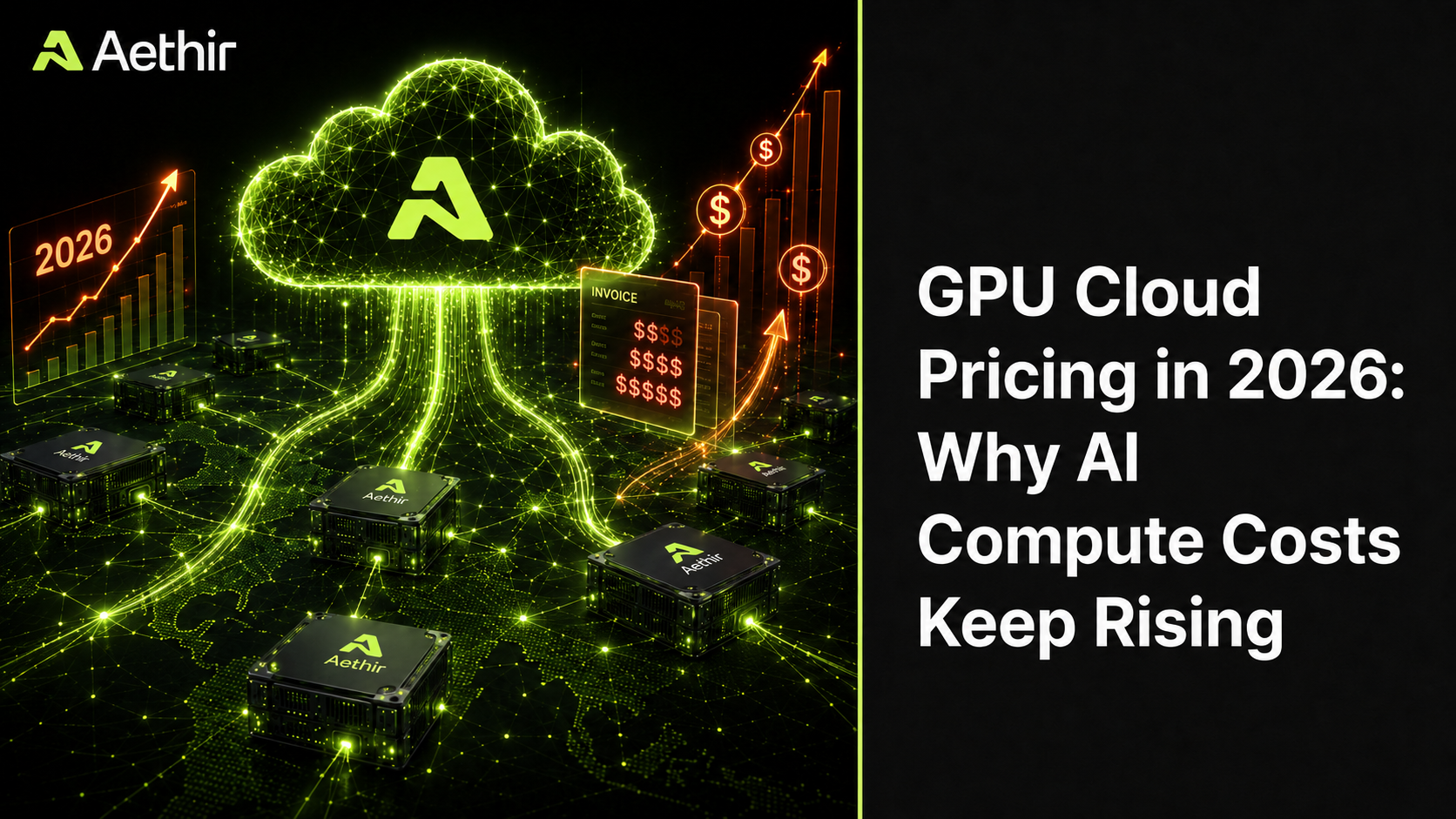
GPU cloud pricing reversed course: On July 1, 2026, AWS raised reserved GPU rates by roughly 20%, its second increase this year. Two decades of steadily falling cloud prices have gone into reverse, and budgets built on the old playbook no longer hold.
The GPU shortage is now a memory shortage: GPU die output has stabilized, but high-bandwidth memory (HBM) is the new bottleneck. HBM capacity sits with a handful of suppliers and takes years to expand, so constrained supply will define 2026 and beyond.
Centralized costs hide beyond the rate card: Idle reservations, egress fees, and single-point pricing power inflate AI compute costs well past the hourly figure. When one vendor raises rates, every customer absorbs the shock at once.
A decentralized GPU cloud absorbs the shock: Aethir aggregates enterprise GPU capacity from independent operators across 94 countries into one on-demand network.
Treat AI infrastructure as a portfolio: Separate training from inference, run agents on Aethir Claw, and consolidate open-source model access through Aethir Mesh.
GPU Cloud Pricing Just Jumped Again at AWS
On July 1, 2026, Amazon Web Services raised rates for EC2 Capacity Blocks, its reservation service for AI accelerators, by roughly 20%, only six months after a 15% rise in January. Teams that reserve cloud GPU capacity have watched GPU cloud pricing climb by more than a third since the year began, and AI compute costs are rising across every roadmap that depends on reserved capacity.
Blackwell B300 instances moved to $14.04 per accelerator hour, while H100-based P5 capacity climbed to $5.191 dollars per hour in US regions. These are the most sought-after accelerators in the cloud GPU market.
AWS lifted the same rates by about 15% in January. Repeated increases on flagship instances signal a structural shift in GPU cloud pricing, not a temporary adjustment. Hyperscalers built their business on steadily falling prices as hardware improved. That era has ended because supply is constrained and demand keeps compounding.
The GPU Shortage Has Moved From Chips to Memory
Why does GPU cloud pricing keep rising when chip production has improved?
Because the GPU shortage has changed shape. GPU die output has largely stabilized, but high-bandwidth memory, the specialized memory stacked next to every modern accelerator, is now the binding constraint, and HBM manufacturing sits with a handful of suppliers.
Reports through the first half of 2026 describe component costs swinging sharply while AI server prices climb month over month. New HBM capacity takes years to build, so relief will not arrive soon.
As a reminder, agentic AI runs continuously rather than answering single prompts, multiplying inference volume per user. At the same time, open-source models such as DeepSeek, Qwen, and GLM are attracting thousands of new teams to the GPU compute market.
Finally, pilots have become production AI workloads, converting experimental budgets into standing commitments for AI infrastructure. Companies need to start planning compute like power or water: As constrained infrastructure.
The Hidden Costs of Centralized Cloud GPU Capacity
Headline rates tell only part of the story. Centralized cloud GPU capacity carries structural costs that inflate AI compute costs well beyond the hourly figure, and concentration means every customer absorbs the same shock at the same time. We unpacked the architecture side of this problem in our breakdown of how GPU colocation meets decentralization.
Where Centralized Costs Hide
Idle reservations: Reservation models force teams to predict demand months ahead and pay for unused hours when workloads dip. Multi-year contracts lock teams into outdated assumptions at exactly the moment flexibility gains value.
Egress fees and data gravity: Hyperscalers commonly charge 8 to 12 cents per gigabyte to move data out. A single 100-gigabyte model checkpoint transfer can cost more than an hour of GPU compute.
Single-point pricing power: The July increase was applied across the entire instance families in a single announcement, with no negotiation and no alternatives within the same walled garden. Single-owner AI infrastructure means single-point pricing power.
How Aethir’s Decentralized GPU Cloud Changes the Equation
Aethir’s decentralized GPU cloud takes a different approach to the same physics. Aethir’s GPU-as-a-Service aggregates enterprise GPU capacity from independent operators worldwide into one orchestrated pool, with more than 430,000 GPU containers across 94 countries.
No single actor sets prices: Supply comes from many independent operators, Cloud Hosts, rather than one balance sheet, so competition inside the pool keeps GPU cloud pricing anchored to real market conditions rather than quarterly margin targets.
On-demand OpEx with no lock-in: Teams pay for the GPU compute they use, without long-term contracts, eliminating the idle reservation problem entirely. AI compute costs track actual usage rather than forecasts driven by GPU shortage anxiety.
A wider supply funnel: Aggregate capacity grows whenever any operator anywhere adds GPUs. Distributed GPU nodes also put inference close to users on every continent without premium regional pricing.
A Playbook for Cutting AI Compute Costs in 2026
Rising GPU cloud pricing is a planning problem, and planning problems have playbooks. The goal is a portfolio approach to AI infrastructure, part reserved, part on demand, part decentralized, so shocks are absorbed instead of passed straight to burn rate.
Three Moves to Make Now
Separate your workloads: Training, fine-tuning, and inference tolerate interruptions, latency, and location differently, so pricing them as a single bucket hides savings. Steady-state inference and burst AI workloads are the easiest to move, and they are the areas where Aethir’s decentralized GPU cloud offers the greatest advantage.
Run agents on Aethir Claw: AI agents run around the clock, which is punishing on premium centralized rates. Aethir Claw bundles access to frontier models into simple subscriptions, built for teams deploying agents without managing infrastructure.
Consolidate open-source LLM access with Aethir Mesh: Aethir Mesh serves open-source models, including DeepSeek, Kimi, GLM, MiniMax, and Qwen, mostly on Aethir GPUs, using a dedicated API key. One integration replaces several vendor relationships and their separate bills.
The era of ever-cheaper centralized compute is over, but rising hyperscaler rates don’t have to set your budget. Aethir delivers enterprise GPU compute on demand, without long-term contracts, through a global decentralized GPU cloud built for AI workloads. Whether you are training models, serving inference, or deploying agents with Aethir Claw and Aethir Mesh, you pay for what you use and scale when you need to.
Explore the Aethir ecosystem and turn AI compute costs from a constraint into an advantage: https://enterprise.aethir.com/
FAQ
Why did GPU cloud pricing increase in 2026?
AWS raised rates for its EC2 Capacity Blocks GPU reservation service by roughly 20% on July 1, 2026, the second increase of the year. The rise reflects a structural shortage of high-bandwidth memory combined with compounding demand from agentic AI, open-source models, and enterprise AI workloads.
What is a decentralized GPU cloud?
A decentralized GPU cloud, often called a DePIN, aggregates enterprise GPU capacity from independent operators worldwide into one on-demand network. Users access GPU compute without long-term contracts, and pricing reflects competition among many suppliers rather than a single vendor.
How does Aethir lower AI compute costs?
Aethir uses an on-demand OpEx model with no long-term contracts, so teams pay only for the compute they use. Supply comes from a distributed network of more than 430,000 GPU containers across 94 countries, which keeps rates competitive and capacity close to end users.