Key Takeaways
The Training Era Is Shifting: In 2026, roughly 70% of GPU compute demand will come from AI inference rather than model training. Most enterprise infrastructure decisions are still calibrated for a training-heavy world that no longer represents the majority of inference workload GPU demand in 2026.
Inference Economics Are Structurally Different: Training requires large synchronized clusters that run for days or weeks. Inference demands burst capacity, geographic distribution, and latency minimization.
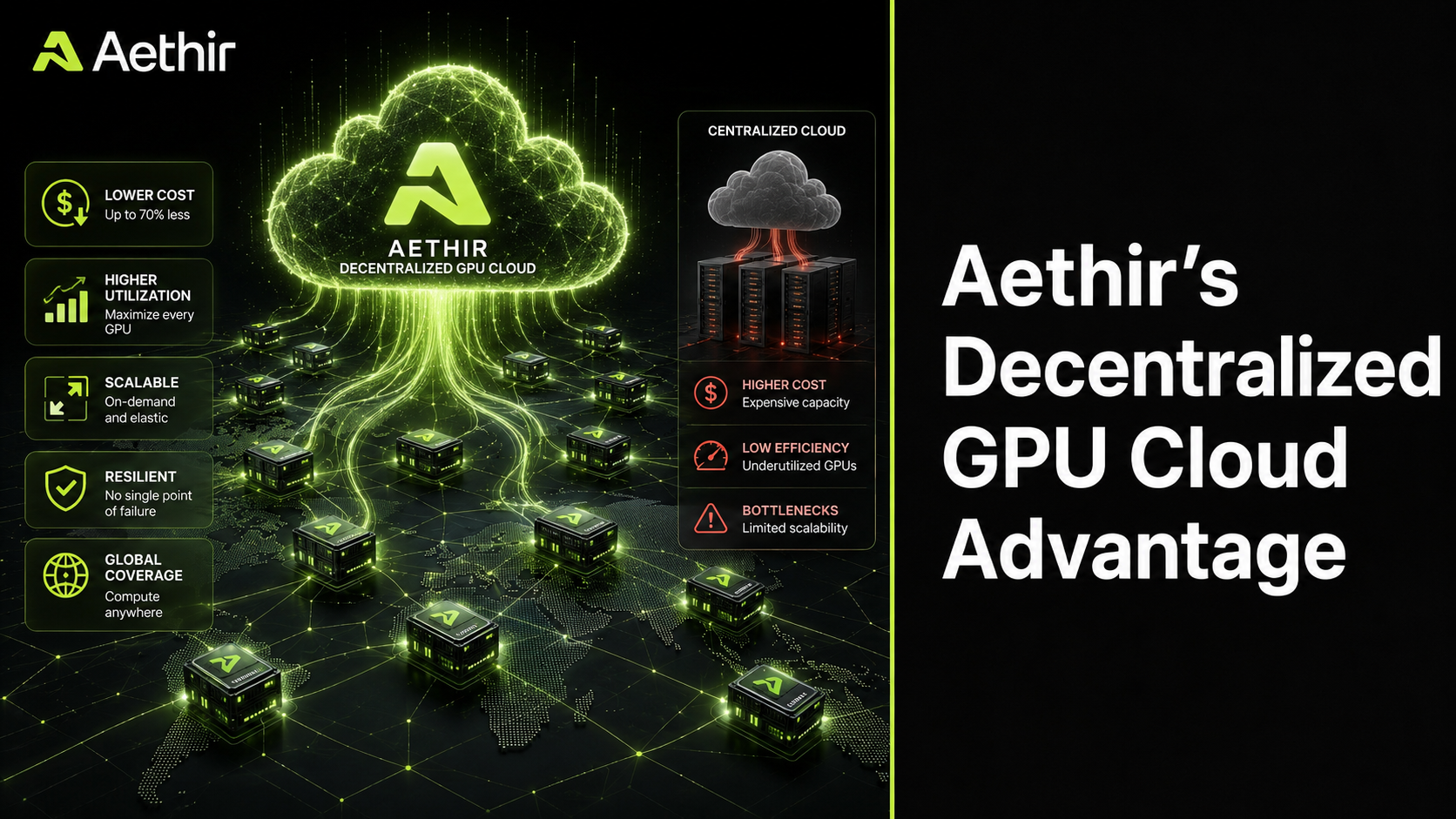
Aethir’s Decentralized GPU Cloud Matches the Inference Workload: Aethir delivers inference compute 40% to 80% cheaper than hyperscaler pricing for equivalent GPU specifications. Fast, on-demand provisioning and zero egress fees remove the two largest hidden cost drivers in production inference environments.
The $2.52T AI Market Is Inference-Driven: With global AI spend projected at $2.52 trillion in 2026, the majority of that capital is flowing into deployment infrastructure, not foundational model training.
B300 at Scale Closes the Performance Gap: Aethir is the first decentralized GPU cloud planning to deploy NVIDIA B300 clusters at production scale.
The Shift From Training to Inference
In 2023, the AI infrastructure conversation centered on training. Massive synchronized GPU clusters, weeks-long compute jobs, and foundational model development at frontier scale. That activity has not stopped, but it is no longer the primary driver of GPU demand. By 2026, roughly 70% of AI GPU compute comes from inference: model serving, real-time API calls, and production deployment across enterprise applications and AI agents running at scale.
Model Proliferation at Enterprise Scale
The number of production AI models deployed across enterprises has grown faster than the underlying compute base built to support them. Every deployed model generates a permanent inference workload, creating GPU demand each time a user, application, or agent makes a request. The compounding effect of millions of daily active users across thousands of production deployments explains why inference has overtaken training as the primary driver of GPU compute spending.
Enterprise Deployment Cycle
Most large enterprises have moved past model evaluation and are now operating AI systems in production. The $2.52 trillion in projected global AI spend in 2026 reflects the AI compute infrastructure shift, with capital flowing into deployment, integration, and serving infrastructure rather than foundational model development. AI inference compute in 2026 is now distributed across every industry vertical, while training at frontier scale remains concentrated among a small number of labs.
AI Agent Demand
Agentic AI systems execute multiple inference calls per task. A single agent running a multi-step workflow may make dozens of model requests before completing a job. As agent deployment scales with active agent populations already in the millions across platforms, the inference demand generated per compute unit far exceeds what any individual training run produces over its lifetime.
Why Inference Demands Different Infrastructure
The infrastructure properties that make a GPU cluster efficient for training are not the same properties that make it efficient for inference. Training optimizes for sustained throughput across long-running synchronized jobs. Inference optimizes for latency, availability, and burst capacity simultaneously, across multiple geographies, with variable demand profiles that shift throughout the day.
Latency Sensitivity
Inference workloads are user-facing or agent-facing, which means they are latency-constrained in ways that batch training jobs are not. A model serving endpoint that takes 3 seconds to respond degrades user experience in a measurable way, whereas the same delay is irrelevant during a 96-hour training run. Infrastructure built around throughput maximization for training introduces latency penalties in production serving environments.
Burst Demand Patterns
Inference demand is not uniform. It spikes with user activity cycles, viral content events, and agent task surges. Hyperscaler reservation models designed for stable, predictable long-running jobs penalize organizations that need to scale inference capacity quickly and release it just as fast. Reserved instance pricing converts burst workloads into permanent capacity costs regardless of actual utilization levels.
Geographic Distribution
Latency-sensitive inference improves when compute is positioned closer to the end user or the application layer. Centralized data center infrastructure concentrates compute in a small number of locations, creating unavoidable network latency for distributed user bases. Aethir’s decentralized GPU-as-a-Service inference network, with GPUs across 94 countries and more than 200 locations, is architecturally suited to inference serving at a global scale.
Aethir’s Decentralized GPU Cloud and Inference Economics
The cost structure of inference on centralized hyperscalers compounds with scale. Every query generates a compute charge. Every data transfer generates an egress fee. Every reserved instance that sits idle during off-peak hours generates a capacity cost. At production inference volumes, these charges are structural costs embedded in the architecture of how hyperscaler clouds were built.
No Egress Fees
Centralized cloud providers charge data egress fees on every token of output data that leaves their infrastructure. For inference workloads that produce large outputs such as code generation, document synthesis, or multi-modal responses, egress fees accumulate per request and per token at scale. Aethir’s decentralized AI inference infrastructure charges no data egress fees, eliminating a cost category that hyperscaler-optimized infrastructure budgets routinely underestimate.
On-Demand Provisioning Speed
Hyperscaler GPU capacity for enterprise workloads operates on reservation queues that can extend weeks or even months. Aethir’s on-demand GPU inference cloud can provision selected types of enterprise GPU clusters in as little as 48 hours. The ability to scale inference capacity within a few business days converts burst demand events from capacity crises into routine provisioning operations that fit within normal operational timelines.
Cost Per Inference Hour
Aethir’s decentralized GPU cloud inference network delivers inference workloads at 40% to 80% lower cost than hyperscaler pricing for equivalent GPU specifications. H100 access on Aethir runs approximately 86 percent below comparable Google Cloud configurations. For organizations running inference continuously at production scale, this cost differential is a primary factor in whether a business model remains viable as request volumes grow.
Aethir’s Decentralized GPU-as-a-Service for the Inference Era
Aethir entered 2026 with 430,000 GPU containers across more than 200 locations in 94 countries, and 1.4 billion compute hours delivered to enterprise clients. Aethir’s upcoming NVIDIA B300 cluster deployment makes Aethir the first decentralized GPU cloud to do so, specifically to support enterprise inference workloads that require training-class hardware without training-scale minimum commitments.
B300 at Inference Scale
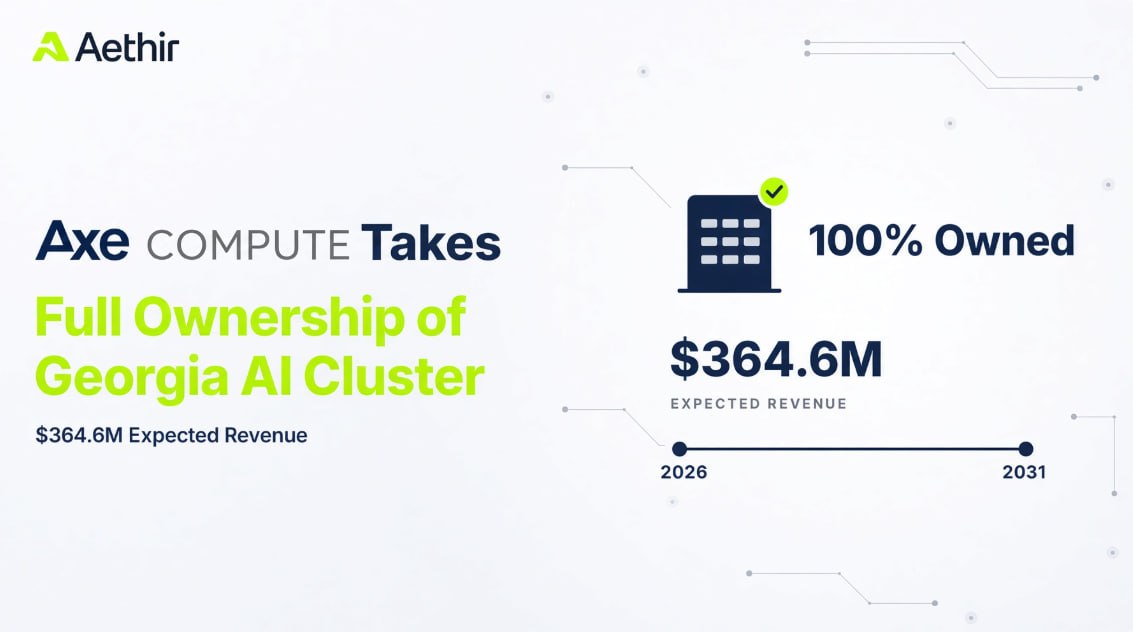
NVIDIA B300 GPUs carry 288GB of HBM3e memory and deliver substantial throughput improvements for large model inference compared to H100 and H200 configurations. Aethir is the infrastructure partner on a 2,304-GPU B300 cluster by Axe Compute’s, deployed as part of a $260 million enterprise deployment deal, demonstrating that B300-class hardware is available through the Aethir network at dedicated cluster scale and not just as spot capacity for experimental workloads.
No Vendor Lock-In
Hyperscaler GPU infrastructure ties data, applications, and compute pipelines to proprietary tooling layers, creating switching costs when workloads need to migrate. Aethir provides bare-metal GPU access without requiring proprietary SDKs, managed networking layers, or platform-specific tooling. Organizations using Aethir can move inference workloads between providers without incurring data transfer fees or re-architecting their serving stack.
Global Inference Reach
With GPU infrastructure distributed across 94 countries, Aethir operates as a DePIN AI inference network, routing requests to the lowest-latency GPUs available for a given user’s geography. This is a structural property of the decentralized network model and not a feature that can be replicated by a centralized provider by adding a single new data center region.
What the Inference Era Means for Enterprise AI Buyers
Enterprise AI buyers making infrastructure decisions in 2026 are operating in a market where the majority of compute spend will go toward serving models in production, not building them. The organizations that calibrate their infrastructure strategy for the inference era by prioritizing cost per inference, provisioning speed, and geographic coverage will hold structural cost advantages over competitors locked into training-era procurement models.
Evaluate Total Cost Per Inference, Not Per Hour
The true cost of inference includes compute charges, egress fees, idle reservation costs, and provisioning lead time penalties. The hyperscaler vs decentralized GPU cost comparison shifts significantly once distributed GPU inference costs, such as egress fees, idle capacity, and reservation overhead, are factored in. Hyperscaler prices for GPU compute do not reflect the full cost structure at production inference volumes. Comparing total cost per inference across centralized and decentralized providers produces a materially different purchasing decision than comparing headline hourly rates.
Match Infrastructure to Workload Type
Large-scale synchronized training still performs best on centralized infrastructure with dedicated high-bandwidth interconnects. Inference, fine-tuning, and burst workloads are better served by distributed GPU networks that provide on-demand access, no egress fees, and geographic flexibility. A hybrid architecture that routes each workload to the infrastructure optimized for that type of workload is the most cost-efficient approach available in 2026.
Plan for Inference at Agent Scale
As AI agent deployments grow, inference demand scales non-linearly. A single agent orchestrating sub-agents can multiply inference call volume by orders of magnitude compared to a single model endpoint. Infrastructure strategies that plan for agent-scale inference volumes by provisioning GPU capacity for multi-step, multi-model request chains will avoid the capacity crises that fixed reservation models create when agentic workloads spike.
Aethir’s decentralized GPU cloud is built for the inference era, providing flexible, on-demand compute services for all types of inference workloads, without hyperscaler limitations and bottlenecks.
Frequently Asked Questions
Why is decentralized GPU infrastructure better suited for inference?
Decentralized GPU infrastructure matches inference workloads because inference requires burst capacity, geographic distribution, and low latency rather than the sustained synchronized throughput that centralized clusters optimize for.
How does Aethir’s decentralized GPU-as-a-Service handle inference at enterprise scale?
Aethir provides enterprise inference capacity through a distributed network of 430,000 GPU containers across 94 countries. Enterprise customers access GPU capacity on demand without minimum reservation commitments, with provisioning timelines as short as 48 hours and no data egress fees that compound with inference volume.
What is the cost difference between hyperscalers and Aethir for inference?
Aethir delivers inference compute at 40% to 80% lower cost than hyperscaler pricing for equivalent GPU specifications. H100 access on Aethir runs approximately 86 percent below comparable Google Cloud pricing. The full cost advantage is larger when accounting for the absence of data egress fees, which accumulate per inference request on centralized cloud infrastructure.