Key Takeaways
- Generative AI creative workflows are enhancing content pipelines with both speed and quality.
- The rise of AI content workflow platforms brings never-before-seen automation opportunities for AI image and video production.
- These platforms need access to reliable and scalable GPU compute.
- Aethir’s decentralized GPU cloud can support the future growth of AI content workflow platforms.
The AI industry has reached a stage where creators have versatile AI content workflow platforms at their disposal, supercharging content production as never before. Creators don’t need to know coding or have design skills to produce breathtaking visuals in a variety of styles and formats. With the emergence of AI content creation pipelines, creators can utilize natural language processing by prompting AI workflow platforms to create specific visuals and video assets.
All of these platforms need one thing to thrive: Access to reliable, scalable, and cost-effective compute, which is precisely what Aethir’s decentralized GPU cloud provides.
AI content creation pipelines have dramatically evolved from simple prompt-based outputs to complex AI workflows with multi-step pipelines that creators can run as production processes. Today, AI workflow platforms offer streamlined access to end-to-end creative pipelines. Creators can ideate, generate, iterate on versions, and publish content immediately.
Thanks to AI image and video generation platforms, content volume expectations are skyrocketing, but creators are often struggling with output quality. That’s because many platforms still prioritize the abundance of AI workflow options and features rather than focusing on curated AI content production workflows. Users need content output consistency together with speed.
Let’s explore the rise of AI workflow platforms to learn more about this exciting innovation of the AI era, and find out how Aethir’s decentralized GPU cloud supports the evolution of AI content workflow platforms.
How AI Image & Video Workflow Platforms Work
AI workflow platforms use GPU-intensive workloads for AI inference tasks that require access to reliable GPU compute with low latency and high elasticity, especially during periods of increased user activity.
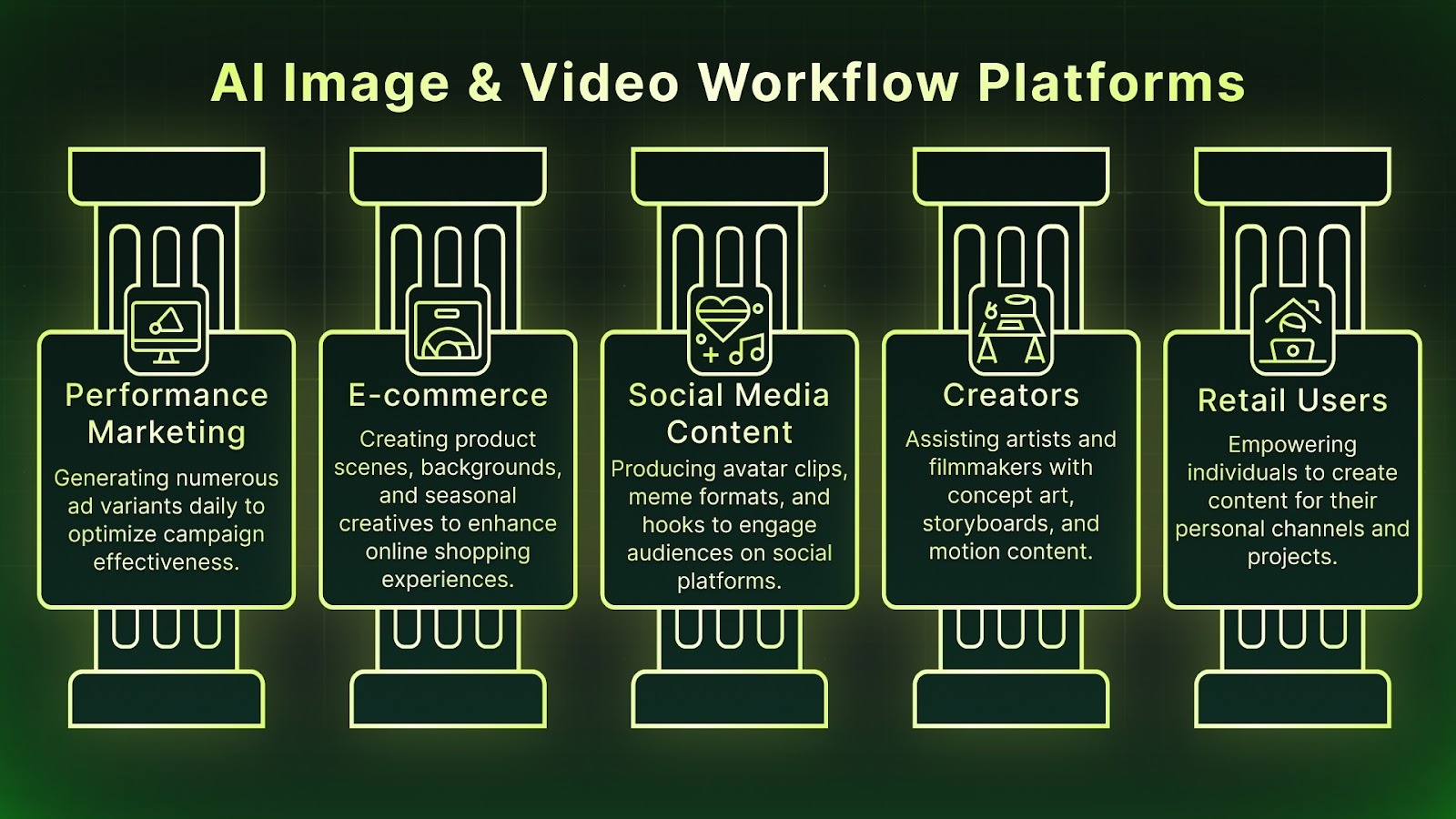
Such platforms can be used for all types of AI image and video generation workflows, including:
- Performance marketing: dozens of ad variants per day
- E-commerce: product scenes, backgrounds, seasonal creatives
- Social media content: avatar/character clips, meme formats, hooks
- Creators: concept art, storyboards, motion content
- Retail users creating content for their personal channels and projects
These are just some of the everyday use cases of AI content workflow platforms, showcasing how generative AI content creation pipelines work, but AI workflow platforms go way beyond.
At their core, AI workflow platforms use leading large language models (LLMs) to generate image and video content. For example, these platforms can integrate models such as ChatGPT or NanoBanana to generate content based on user input.
Users can provide text input or add visuals and videos, depending on the content being created, including reference images, brand kits, style guides, product photos, or audio for lip-sync.
What makes an AI workflow is the control layer that includes multiple steps in the process to create a final output:
- Prompt templates, reusable presets, seed control, shot controls
- Masking/inpainting, motion controls, camera moves
- Multi-step chaining: generating, refining, upscaling, animating
Along with the control layer, there’s an iteration loop to improve output, and the production layer allows creators to export to various formats and ratios as needed.
Key Characteristics of High Quality AI Workflow Platforms
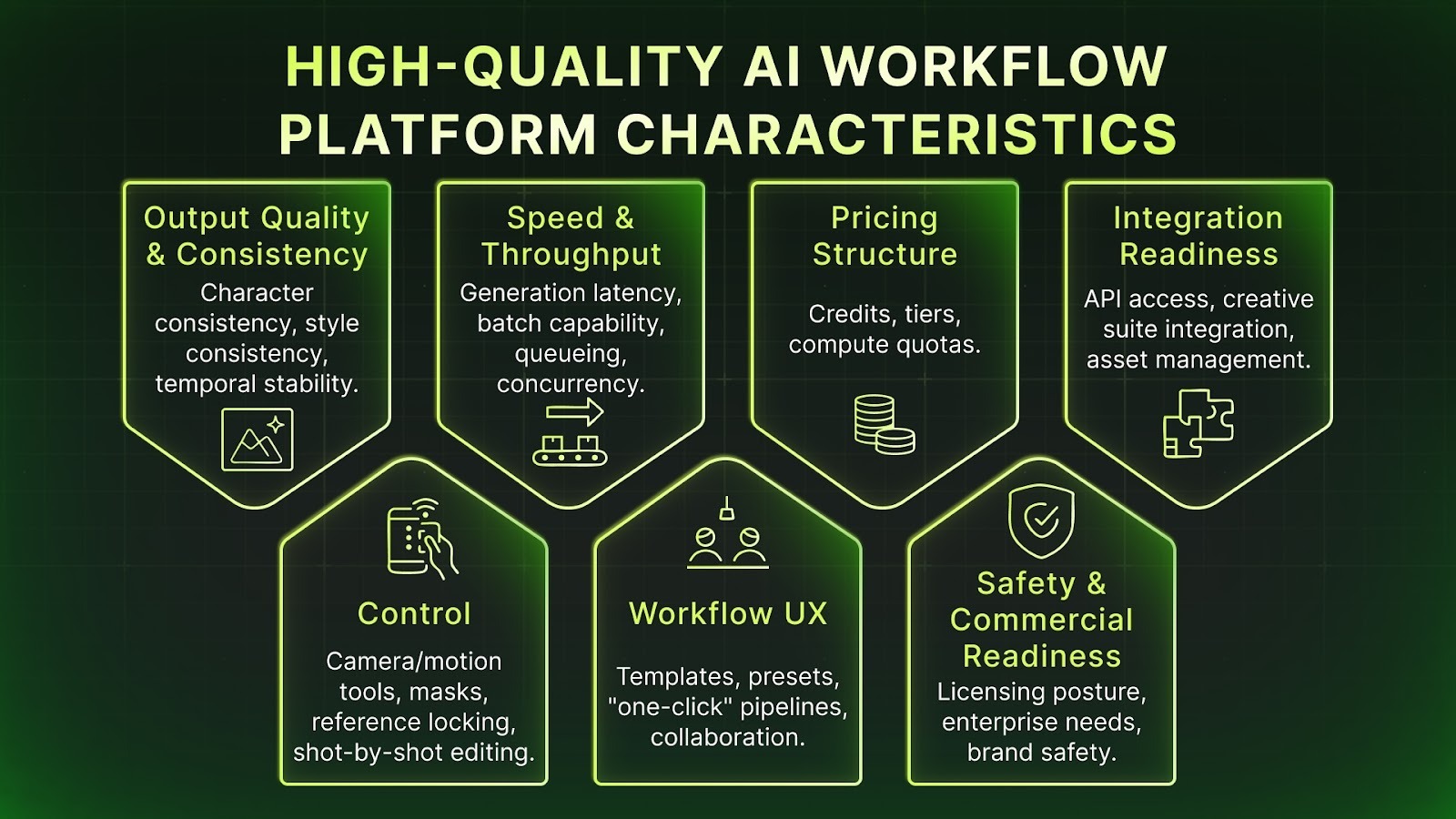
There are dozens of AI workflow platforms offering different types of image and video automation services. However, for the average user, it can be difficult to differentiate true quality from platforms that offer subpar performance. As we know, AI visual outputs have gone a long way in the past year, with some large language models (LLMs) producing way better outputs than others, specialized for coding, deep thinking, and other inference workloads.
Users can easily get overwhelmed by AI workflow platform interfaces that sometimes have hundreds of features, different AI model types, visual formats, and output types. For content creators, it’s essential to identify the key features and platform characteristics that best suit their production needs.
High-quality AI workflow platforms have the following characteristics:
- Quality & consistency: Character consistency, style consistency, temporal stability (video)
- Control: Camera/motion tools, masks, reference locking, shot-by-shot editing
- Speed & throughput: Generation latency, batch capability, queueing, concurrency
- Workflow UX: Templates, presets, “one-click” pipelines, collaboration
- Pricing structure: Credits, tiers, compute quotas
- Safety & commercial readiness: Licensing posture, enterprise needs, brand safety
- Integration readiness: API access, creative suite integration, asset management
AI workflow platforms that excel across all of these fields are a great all-around solution for most image and video content workflows, including text-to-video, image-to-video, and other trending generative AI creative workflows.
Finally, all of these characteristics depend on the underlying compute infrastructure, as AI workflow platforms require uninterrupted streams of high-performance GPU compute to serve large volumes of concurrent users.
5 Popular AI Image/Video Workflow Platforms
The AI workflow platform sector has been booming, with various products emerging to address growing user demand for versatile generative AI creative workflows. There are already various high-quality platforms for text-to-video workflows, image-to-video generation, and other visual AI workflows. Still, to offer you an overview of the sector, we’ve prepared a curated list of 5 popular AI workflow platforms that are trending on the market.
CivitAI
CivitAI serves as a community-driven hub for generative image and video models, workflows, and LoRAs (Low-Rank Adaptations) primarily focused on the Stable Diffusion text-to-image AI ecosystem. Its core strengths lie in discoverability, remixing, and rapid experimentation, enabling creators to build on shared assets. The platform offers numerous options for advanced users, making it powerful for experienced AI content creators, but less suitable for teams.
Best for: Model and LoRA-based image generation workflows, image-to-image refinement workflows, experimental video and animation workflows.
ComfyUI
ComfyUI is a node-based, highly modular interface for building custom AI image and video workflows. It’s for tech-savvy users who want complete control over every step of their workflows, from conditioning to sampling and post-processing. This flexibility makes it ideal for advanced creators and developers who want deterministic, repeatable pipelines. The trade-off is increased complexity and heavy compute usage, especially in chained or batch workflows. It is workflow-native, not prompt-centric.
Best for: Custom diffusion pipelines, batch generation, variant testing workflows, image-to-video, and animation workflows.
RunningHub
RunningHub positions itself as an execution layer for AI workflows, abstracting infrastructure while enabling users to run complex pipelines at scale. It emphasizes speed, automation, and reproducibility over manual tweaking. Users can deploy workflows without managing local environments or GPUs. This makes it attractive for teams and creators who prioritize throughput and reliability.
Best for: Prebuilt workflow execution, automated batch rendering workflows, reusable team workflows.
Higgsfield
Higgsfield focuses on creator-friendly AI video and image workflows optimized for social and short-form content. The platform emphasizes simplicity, presets, and fast iteration rather than deep technical control. Its workflows are designed to minimize friction between idea and publishable output. This ease of use drives high-frequency video generation.
Best for: Text-to-video short-form workflows, image-to-video motion workflows, template-based content workflows.
OpenArt
OpenArt blends model access, workflow templates, and a creator marketplace into a single AI content platform. It supports both novice and advanced users by offering pre-built workflows alongside customization options. Collaboration, reuse, and scaling content production are central to its design. The platform sits between experimentation and production.
Best for: Template-driven image generation workflows, creative remix, collaboration workflows, production-oriented content workflows.
Why AI Workflow Platforms Need Aethir’s Decentralized GPU Cloud to Grow
AI workflow platforms require steady, high-performance GPU access to operate smoothly, given the hardware requirements of generative AI content creation pipelines. User base growth and adoption are defined by infrastructure access and scalability. AI content workflow platforms need scalable AI compute infrastructure to onboard new user cohorts and increase workflow capacity to meet user demand.
However, most leading AI workflow platforms use centralized cloud infrastructure provided by traditional hyperscale cloud providers. These providers charge hefty service fees, impose strict user contracts, and aren’t capable of supporting real-time GPU compute scalability needed for the fastest-growing AI workflow platforms.
Aethir’s decentralized GPU cloud offers a viable solution for the compute bottleneck faced by AI workflow platforms through its distributed network architecture. Instead of a few centralized hyperscaler data centers, Aethir uses a distributed Cloud Host network of nearly 440,000 premium-quality GPU Containers, including NVIDIA H100s, H200s, B200s, and more.
For AI content workflow platforms, Aethir’s decentralized GPU cloud offers reliable, scalable, and cost-effective GPU compute across 94 countries worldwide, provided by Cloud Hosts in 200+ locations.
The evolution of AI workflow platforms requires scalable cloud computing, and Aethir’s decentralized GPU cloud delivers the compute needed to streamline advanced AI content creation pipelines.
Discover more about Aethir’s decentralized GPU cloud in our official blog section.
Explore our enterprise-grade GPU compute offering here.
FAQs
What are AI content workflow platforms?
AI content workflow platforms enable creators to generate, iterate, and publish image and video content through multi-step AI pipelines rather than single-prompt outputs.
Why do AI image and video workflows require significant GPU compute?
Image and especially video generation rely on GPU-intensive inference tasks that demand low latency, high throughput, and elastic scaling during peak usage.
How does Aethir support the growth of AI workflow platforms?
Aethir’s decentralized GPU cloud provides scalable, cost-efficient, and globally distributed GPU compute, enabling AI workflow platforms to grow without being constrained by centralized cloud bottlenecks. Through partners and customers like Lyn and Respeecher, Aethir’s decentralized GPU cloud is already showing hands-on support for AI content creator workloads.